
Ancient Art and Antiquities For Sale

Cart

View Cart
  • No products in the cart.
  • My Account
    • Edit address
    • Change password
    • View order
  • English
  • Login / Register
  • HOME
  • SHOP
  • ABOUT US
  • BLOG
  • CONTACT
  • BILIANAK.
  • PHOENIX ANCIENT ART
Back to top

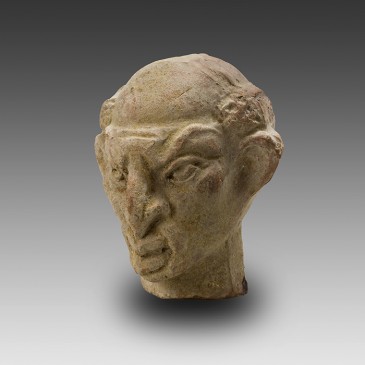
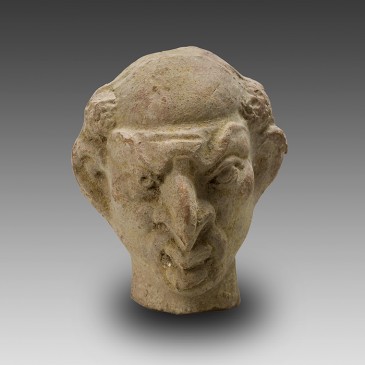
Grotesque Terracotta Head (perhaps a Mime or an Actor)

Home  / Sculpture / Grotesque Terracotta Head (perhaps a Mime or an Actor)
View cart “Roman Marble Relief representing the “Thracian Horseman”” has been added to your cart.
  • Grotesque Terracotta Head (Mime or Actor)
  • Grotesque Terracotta Head (Mime or Actor)

Grotesque Terracotta Head (perhaps a Mime or an Actor)

Grotesque Terracotta Head (perhaps a Mime or an Actor)

The statuettes of “grotesques” often represented mimes, street actors, music players, dancers, or even street vendors or workers suffering from physical deformities or afflictions that the sculptors treated in an exaggerated manner, to create a caricature-like effect. At the end of the Hellenistic period, in the large urban centers such as Rome and Alexandria, the theatrical genre of pantomime (according to tradition, this genre was created by Sophron of Syracuse in the 5th century B.C. already) was very popular.

Greek, Hellenistic, Roman
1st century A.D., 1st century B.C.
H: 9 cm

In stock

In stock

Price:CHF 8'200

Category: Sculpture. Tags: Actor, Greek, Grotesque Terracotta Head (perhaps a Mime or an Actor), Head, Hellenistic, Man, Roman, terracotta, theater, theatre.

Love it, share it!

  • Description
  • Additional information
  • Product Inquiry

Product Description

This male head is cut straight under the neck. It is hollow and would have been molded in a bivalve mold. An unusual detail for this type and size of objects: the suspension ring soldered in the back of the neck, that would have served to attach the head to a support, the nature of which is currently unknown. The face shows the exaggerated and archetypal features of the Greek-Roman images known as “grotesque”: big aquiline and pointed nose, frowning and strongly marked eyebrows, wrinkled forehead, prominent cheekbones, full lips, baldness with a lateral crown of hair.

The technical and artistic qualities of this piece are a good example of similar terracotta pieces, which were generally mass-produced in coarse clay and sold as simple souvenirs, as ex-votos or as elements for funerary furniture. The statuettes of “grotesques” often represented mimes, street actors, music players, dancers, or even street vendors or workers suffering from physical deformities or afflictions that the sculptors treated in an exaggerated manner, to create a caricature-like effect. Unlike the actors of comedy and classical theater, the mimes and actors who performed in the street did not wear masks, and the female roles were played by women, and not by disguised men.

At the end of the Hellenistic period, in the large urban centers such as Rome and Alexandria, the theatrical genre of pantomime (according to tradition, this genre was created by Sophron of Syracuse in the 5th century B.C. already) was very popular, especially among the lower classes of society: the imitation and caricature of the members of the ruling class was so vehement, that, in the early Imperial period, mimes were strictly controlled, before being prohibited by Domitian in the late 1st century A.D.

Additional information

Culture

Greek, Hellenistic, Roman

Datation

1st century A.D., 1st century B.C.

Dimensions

H: 9 cm

Type

Sculpture

Material

Terracotta

Colors

Beige

Condition

Complete, in excellent condition; minor chips. Surface covered with a light crust of gray-beige sand. An old label written in black ink is glued behind the neck.

Serial Number

30192

Other Products

  • Details Add to cart
    ADDED

    Statuette of a Human-Headed Bull

    Statuette of a Human-Headed Bull

    This Statuette of a Human-Headed Bull represents a very popular mythological hybrid figure that was largely widespread in Near Eastern iconography (especially in glyptics) from the Sumerian period, that is the bull with a bearded human head, wearing a headgear (tiara) adorned with a single pair of horns.

    CHF 9'200 Read More
  • Greek terracotta figure showing the myth of Europe
    Details Add to cart
    ADDED

    Greek terracotta figure showing the myth of Europe

    Greek terracotta figure showing the myth of Europe

    The group comprises two figures: with natural grace, a young woman rides astride a bull that is galloping rapidly towards the viewer’s right. Indeed, the young woman is Europa (the mythological figure after whom our continent is named), who was one of the three daughters of the King of Tyre (a major Phoenician coastal city). She was abducted by Zeus on the beach where she was playing with her sisters: the god appeared to her in the form of a magnificent white bull and carried her, riding the waves of the sea, all the way to Crete.

    CHF 8'500 Read More
  • Greek Terracotta Statuette of a Standing Actor
    Details Add to cart
    ADDED

    Greek Terracotta Statuette of a Standing Actor

    Greek Terracotta Statuette of a Standing Actor

    The statuette depicts a standing man, with a mask, which characterizes him as an actor. He is dressed in a large cloak. As it is usually the case at that time for terracotta examples, our figurine was molded in two parts, the front and the back.

    CHF 14'500 Read More

Blog

Antique Idols

As soon as humans were able to think, they consistently […]

Antiquity’s Colors

English Translation Soon Les œuvres qui nous sont parvenues de […]

Glassware production

Glass, a luxury and exquisite material, whose technical virtuosity reached […]

Categories

  • Artifacts
  • Events & exhibitions
  • Facts & Figures
  • The gallery
  • FAQs
  • Terms of Use
  • Terms of Sale
  • Contact us

©Designed by Webgenève - Création de site internet


Rue Etienne Dumont, 9 1204 Geneva
Tel. +4122 301 9378
Email: contact@young-collectors.com

This website uses cookies. If you continue browsing this website, your action is considered to be a cookie policy acceptance.
