
Hunchback Statuette (?)

Hunchback Statuette (?)
Hunchback Statuette (?)
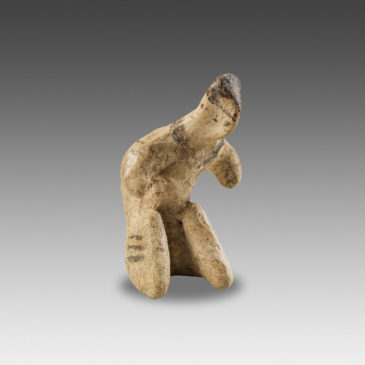
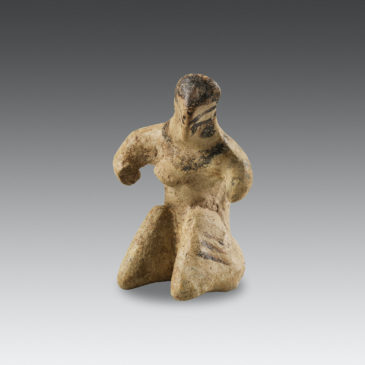
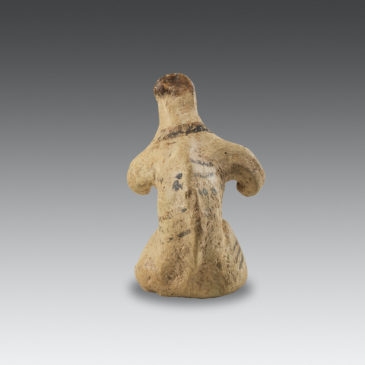
Hand-modelled, the sculpture depicts a figure of indeterminate gender, characterised above all by the obvious deformation of its spine: its back forms a large hump, emphasised by the spine, which is slightly raised, and by the rendering of the ribs, painted dark brown. This deformity causes the figure’s torso to lean abnormally forwards and to the left.
5th millenium B.C., 7th millenium B.C.
H : 6.6 cm
Product Description
Hand-modelled, the sculpture depicts a figure of indeterminate gender, characterised above all by the obvious deformation of its spine: its back forms a large hump, emphasised by the spine, which is slightly raised, and by the rendering of the ribs, painted dark brown. This deformity causes the figure’s torso to lean abnormally forwards and to the left.
That aside, the typology and style of this image correspond to those of the so-called Tell Halaf figurines, as evidenced by its seated position with bent knees, its arms bent and drawn in towards the torso (the chest is not depicted), the shape of its head (simply modelled by pinching the clay between two fingers) and the brown painted lines that highlight certain anatomical details (eyes, hair, neckline, vertebrae and ribs, legs) and/or the presence of tattoos or adornments.
The so-called Halaf culture originated in the northern regions of Mesopotamia (present-day northern Syria and eastern Anatolia) and is characterised above all by the production of high-quality painted pottery, rich in forms and natural or linear decorative motifs.
The prevalence of images of voluptuous women is a clear indication of the importance that the agro-pastoral communities of the time attached to fertility and fruitfulness as principles of survival. Established before the advent of agriculture and the development of urbanisation, this symbolism of womanhood – associated with its male counterpart, represented by the bull – would spread throughout the East and the Mediterranean.


