
Ancient Art and Antiquities For Sale

Cart

View Cart
  • No products in the cart.
  • My Account
    • Edit address
    • Change password
    • View order
  • English
  • Login / Register
  • HOME
  • SHOP
  • ABOUT US
  • BLOG
  • CONTACT
  • BILIANAK.
  • PHOENIX ANCIENT ART
Back to top

Hunchback Statuette (?)

Home  / Idols / Hunchback Statuette (?)
View cart “Byzantine stone animal: double-headed” has been added to your cart.
  • Hunchback Statuette
  • Hunchback Statuette-11984-2

Hunchback Statuette (?)
Hunchback Statuette (?)

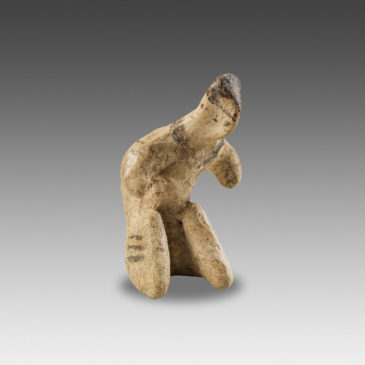
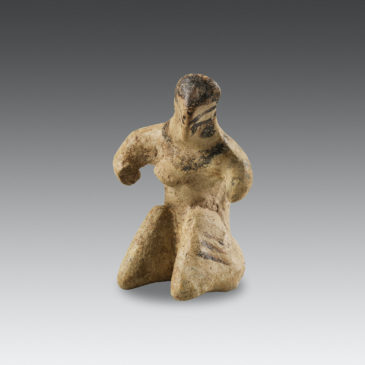
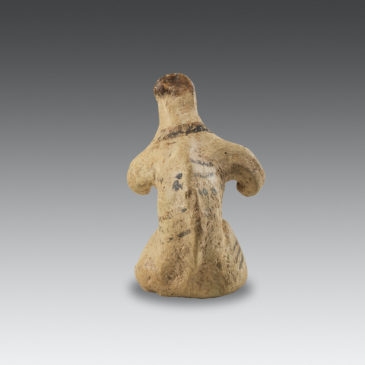
Hand-modelled, the sculpture depicts a figure of indeterminate gender, characterised above all by the obvious deformation of its spine: its back forms a large hump, emphasised by the spine, which is slightly raised, and by the rendering of the ribs, painted dark brown. This deformity causes the figure’s torso to lean abnormally forwards and to the left.

Near Eastern
5th millenium B.C., 7th millenium B.C.
H : 6.6 cm

Price:CHF 3'200

Categories: Idols, Sculpture. Tags: Figure, Human, Hunchback Statuette, Near Eastern, Statuette, terracotta.

Love it, share it!

  • Description
  • Additional information
  • Product Inquiry

Product Description

Hand-modelled, the sculpture depicts a figure of indeterminate gender, characterised above all by the obvious deformation of its spine: its back forms a large hump, emphasised by the spine, which is slightly raised, and by the rendering of the ribs, painted dark brown. This deformity causes the figure’s torso to lean abnormally forwards and to the left.

That aside, the typology and style of this image correspond to those of the so-called Tell Halaf figurines, as evidenced by its seated position with bent knees, its arms bent and drawn in towards the torso (the chest is not depicted), the shape of its head (simply modelled by pinching the clay between two fingers) and the brown painted lines that highlight certain anatomical details (eyes, hair, neckline, vertebrae and ribs, legs) and/or the presence of tattoos or adornments.

The so-called Halaf culture originated in the northern regions of Mesopotamia (present-day northern Syria and eastern Anatolia) and is characterised above all by the production of high-quality painted pottery, rich in forms and natural or linear decorative motifs.

The prevalence of images of voluptuous women is a clear indication of the importance that the agro-pastoral communities of the time attached to fertility and fruitfulness as principles of survival. Established before the advent of agriculture and the development of urbanisation, this symbolism of womanhood – associated with its male counterpart, represented by the bull – would spread throughout the East and the Mediterranean.

Additional information

Culture

Near Eastern

Datation

5th millenium B.C., 7th millenium B.C.

Dimensions

H : 6.6 cm

Type

Idol, Sculpture

Material

Terracotta

Colors

Beige, Black, Brown

Condition

Complete, even if arms are lost. Superficial wear.

Serial Number

11984

Other Products

  • Seal in the Shape of a Lion's Head
    Details Add to cart
    ADDED

    Seal in the Shape of a Lion’s Head

    Seal in the Shape of a Lion’s Head

    Modeled in the shape of a stylized leonine protome (the head is complete, but the body is a simple half-circle representing the mane of the animal), it was carved from a cream-colored limestone veined with red; it is pierced vertically by a hole and was therefore intended to be worn as a pendant (necklace or bracelet).

    The flat lower part of the object actually bears the seal of the owner and of his goods: it is adorned with drawings made with a bouterolle (a sort of drill).

    CHF 5'900 Read More
  • Byzantine stone animal : double-headed
    Details Add to cart
    ADDED

    Byzantine stone animal: double-headed

    Byzantine stone animal: double-headed

    Carved from two fragments of dark green stone mottled with light patches (steatite probably), these two objects represent animals with highly stylized and abstract shapes.

    CHF 2'300 Read More
  • Greek terracotta figure showing the myth of Europe
    Details Add to cart
    ADDED

    Greek terracotta figure showing the myth of Europe

    Greek terracotta figure showing the myth of Europe

    The group comprises two figures: with natural grace, a young woman rides astride a bull that is galloping rapidly towards the viewer’s right. Indeed, the young woman is Europa (the mythological figure after whom our continent is named), who was one of the three daughters of the King of Tyre (a major Phoenician coastal city). She was abducted by Zeus on the beach where she was playing with her sisters: the god appeared to her in the form of a magnificent white bull and carried her, riding the waves of the sea, all the way to Crete.

    CHF 8'500 Read More

Blog

Antique Idols

As soon as humans were able to think, they consistently […]

Antiquity’s Colors

English Translation Soon Les œuvres qui nous sont parvenues de […]

Glassware production

Glass, a luxury and exquisite material, whose technical virtuosity reached […]

Categories

  • Artifacts
  • Events & exhibitions
  • Facts & Figures
  • The gallery

Archives

  • December 2015
  • June 2015
  • March 2015
  • January 2015
  • December 2014
  • November 2014
  • October 2014
  • September 2014
  • August 2014
  • FAQs
  • Terms of Use
  • Terms of Sale
  • Contact us

©Designed by Webgenève - Création de site internet


Rue Etienne Dumont, 9 1204 Geneva
Tel. +4122 301 9378
Email: contact@young-collectors.com

This website uses cookies. If you continue browsing this website, your action is considered to be a cookie policy acceptance.
