
Ancient Art and Antiquities For Sale

Cart

View Cart
  • No products in the cart.
  • My Account
    • Edit address
    • Change password
    • View order
  • English
  • Login / Register
  • HOME
  • SHOP
  • ABOUT US
  • BLOG
  • CONTACT
  • BILIANAK.
  • PHOENIX ANCIENT ART
Back to top

Statuette of a women breast-feeding a child

Home  / Ex-Voto / Statuette of a women breast-feeding a child
View cart “Centered idol” has been added to your cart.

Statuette of a women breast-feeding a child

Statuette of a women breast-feeding a child

This statuette belongs to a significant series of figurines with similar characteristics originating from the Phoenician and Punic worlds. Generally dated to the 7th–6th centuries B.C., they may be standing or seated, holding a child or various attributes (musical instruments, a fan, ears of grain, etc.) or simply holding their breast or belly: in the latter case, they are often called dea gravida

Phoenician, Levantine, Biblical
6th century B.C., 7th century B.C.
H 12.7 cm

Price:CHF 8'200

Categories: Ex-Voto, Sculpture. Tags: Levantine, Statuette, Statuette of a women breast-feeding a child, terracotta, Woman.

Love it, share it!

  • Description
  • Additional information
  • Product Inquiry

Product Description

The statuette was partially cast (head and torso); the arms and legs, the seat, and the child were made by hand and attached before firing. The square base, on which the woman rested her feet, has a hole in it (a vent to regulate the firing process).

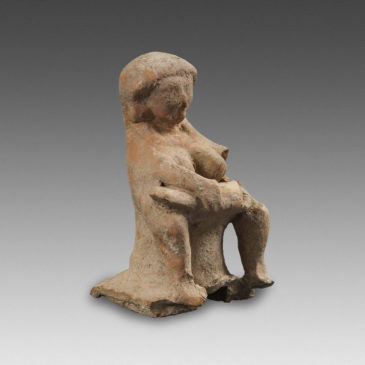
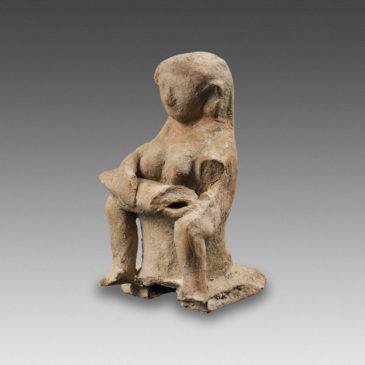
The statuette depicts a subject that was very dear to ancient Near Eastern cultures: a mother nursing her child. The woman is seated on a large cylindrical seat and holds the baby, fully swaddled, on her spread-apart knees; the child would have been comfortably nestled in the crook of her mother’s left arm while feeding.

The woman has a triangular face and a small, pointed nose; her eyes and large ears were highlighted with reddish-brown paint; her necklace and perhaps her tiara were also painted. Her hair, which covers her head like a cap with wavy bangs, then falls over her shoulders in a flat mass, reflecting an Egyptian fashion.

There are other traces of coloring (the child’s body, the woman’s arms and legs), though it is no longer possible to determine precisely which details were originally depicted.

This statuette belongs to a significant series of figurines with similar characteristics originating from the Phoenician and Punic worlds. Generally dated to the 7th–6th centuries B.C., they may be standing or seated, holding a child or various attributes (musical instruments, a fan, ears of grain, etc.) or simply holding their breast or belly: in the latter case, they are often called dea gravida. A few statuettes of mothers holding a child in their arms are known, but the woman is normally depicted standing rather than seated on a throne.

Stylistically, especially in their overall forms and facial features, these images already show a certain Greek artistic influence.
It is reasonable to assume that such an artifact was an ex-voto offered by a Phoenician mother at a sanctuary as a token of gratitude for a birth or as a prayer for future motherhood.

Additional information

Culture

Phoenician, Levantine, Biblical

Datation

6th century B.C., 7th century B.C.

Dimensions

H 12.7 cm

Type

Sculpture

Material

Terracotta

Colors

Red

Condition

Almost complete and in good condition. The left arm of the woman, as well as the head of the baby are lost. The head is re-glued. Superficial wear, concretions and polychromy remains.

Serial Number

11495-2

Other Products

  • Statuette of a Dwarf Warrior-21364
    Details Add to cart
    ADDED

    Statuette of a Dwarf Warrior

    Statuette of a Dwarf Warrior

    Early Imperial Romain Bronze Statuette of a Dwarf Warrior from the 1st-2nd century A.D. The statuette, made of solid bronze, was cast using the lost-wax technique. The statuette, made of solid bronze, was cast using the lost-wax technique. It was attached to its base (of which no trace remains) by a tenon visible beneath the raised foot.

    CHF 7'000 Read More
  • Details Add to cart
    ADDED

    Statuette of a Human-Headed Bull

    Statuette of a Human-Headed Bull

    This Statuette of a Human-Headed Bull represents a very popular mythological hybrid figure that was largely widespread in Near Eastern iconography (especially in glyptics) from the Sumerian period, that is the bull with a bearded human head, wearing a headgear (tiara) adorned with a single pair of horns.

    CHF 9'200 Read More
  • Grotesque Mask (Mime or Aulos Player)
    Details Add to cart
    ADDED

    Grotesque Mask (Mime or Aulos Player)

    Grotesque Mask (Mime or Aulos Player)

    This face certainly represents a male figure; it shows some of the distinctive features of the Greek-Roman images known as “grotesque”, such as the big aquiline and pointed nose, the strongly marked, frowning eyebrows and the wrinkled forehead.

    CHF 6'400 Read More

Blog

Antique Idols

As soon as humans were able to think, they consistently […]

Antiquity’s Colors

English Translation Soon Les œuvres qui nous sont parvenues de […]

Glassware production

Glass, a luxury and exquisite material, whose technical virtuosity reached […]

Categories

  • Artifacts
  • Events & exhibitions
  • Facts & Figures
  • The gallery
  • FAQs
  • Terms of Use
  • Terms of Sale
  • Contact us

©Designed by Webgenève - Création de site internet


Rue Etienne Dumont, 9 1204 Geneva
Tel. +4122 301 9378
Email: contact@young-collectors.com

This website uses cookies. If you continue browsing this website, your action is considered to be a cookie policy acceptance.
