
Ancient Art and Antiquities For Sale

Cart

View Cart
  • No products in the cart.
  • My Account
    • Edit address
    • Change password
    • View order
  • English
  • Login / Register
  • HOME
  • SHOP
  • ABOUT US
  • BLOG
  • CONTACT
  • BILIANAK.
  • PHOENIX ANCIENT ART
Back to top

Phrygian Bronze Cup

Home  / Metalwork / Phrygian Bronze Cup

View cart “Silver Phiale with Repousse Decoration” has been added to your cart.
  • Phrygian Bronze Bowl

Phrygian Bronze Cup

Phrygian Bronze Cup

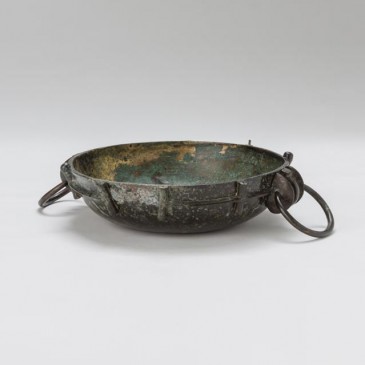
This bronze cast vessel was polished, while the handles and decorations were hammered and/or decorated in repoussé.

Anatolian
6th century B.C.
D: 20 cm

In stock

In stock

Price:CHF 13'000

Categories: Metalwork, Vessels. Tags: 6th century BC, Anatolia, Bowl, Bronze, Phrygian, Phrygian Bronze Bowl, Vessel.

Love it, share it!

  • Description
  • Additional information
  • Product Inquiry

Product Description

This bronze cast vessel was polished, while the handles and decorations were hammered and/or decorated in repoussé.

It is low with a perfectly rounded profile, and a flat bottom that provides a good balance. The two semi-circular, large handles are maintained by two coil-shaped attachments. This adornment is held in place by two rivets, clearly visible inside the cup. The decoration is completed by four thick edges soldered horizontally on each side of the handles, punctuated by vertical lines; they are surmounted by semi-spherical nail heads.

Such vessels are well-attested in Anatolia during the second half of the 8th century B.C., as documented especially by the excavations of monumental tombs discovered near Gordion, the capital of ancient Phrygia. Some were made of precious metal (bronze) and were intended for the high classes of society, but there are also wood examples (probably provided with bronze handles) and ceramic specimens. As it is often the case, these ceramic versions should be considered as imitations of lesser value used by the more humble classes. Before being placed in the tomb, these cups probably served in daily life, as drinking vessels at banquets or as cult containers during religious rites.

The oldest examples, like ours, come from Phrygia, where bronze craftsmen had created the prototypes, later imitated in various areas of the Eastern Mediterranean. Such vessels were probably manufactured until the early 6th century B.C.

Phrygia was a region of west-central Anatolia, famous for having been the kingdom of Midas, who received from Dionysus the power to turn into gold everything he touched. Politically, this region dominated the Anatolian world between the collapse of the Hittite Empire (late 2nd millennium B.C.) and the rise of the Lydian Kingdom (7th century B.C.), which was in turn invaded by the Medes in the 6th century B.C.

Additional information

Culture

Anatolian

Datation

6th century B.C.

Dimensions

D: 20 cm

Type

Metalwork, Vessel

Material

Bronze

Colors

Black, Green

Condition

Complete and in excellent condition, nail heads are partly lost. A small hole and minor cracks in the bottom. The original golden surface of the bronze is still visible (especially on the inside); beautiful green or dark brown patina on the rest of the surface.

Serial Number

11095

Other Products

  • Details Add to cart
    ADDED

    Near Eastern Spouted Bowl

    Near Eastern Spouted Bowl

    This hemispherical vessel is provided, near the lip, with a horizontal, perfectly cylindrical spout. It is simply decorated with a frieze of zigzag pattern in relief. Despite its reduced size, this vessel is outstanding for its technical precision: all the details of the shape and decoration were carefully executed.

    CHF 1'800 Read More
  • Details Add to cart
    ADDED

    Hemispherical Green Stone Bowl

    Hemispherical Green Stone Bowl

    Perfectly hemispherical and without lip, this bowl is supported by a small circular base in very low relief that does not provide a good balance.

    CHF 900 Read More
  • Details Add to cart
    ADDED

    Small Bowl

    Hellenistic Small Glass Bowl

    This core-formed bowl is simply decorated with lathe-cut grooves just below the lip. The base is slightly concave. Towards the end of the Hellenistic period, glass definitely supplanted clay as a raw material for the manufacture of containers in all areas of daily life. With versatility like no other known material in ancient times, abundant availability, lightness and ease of use, glass enabled the imitation of a wide range of other materials (precious metals especially), whether in the form, the design or the color.

    CHF 1'400 Read More

Blog

Antique Idols

As soon as humans were able to think, they consistently […]

Antiquity’s Colors

English Translation Soon Les œuvres qui nous sont parvenues de […]

Glassware production

Glass, a luxury and exquisite material, whose technical virtuosity reached […]

Categories

  • Artifacts
  • Events & exhibitions
  • Facts & Figures
  • The gallery
  • FAQs
  • Terms of Use
  • Terms of Sale
  • Contact us

©Designed by Webgenève - Création de site internet


Rue Etienne Dumont, 9 1204 Geneva
Tel. +4122 301 9378
Email: contact@young-collectors.com

This website uses cookies. If you continue browsing this website, your action is considered to be a cookie policy acceptance.
