
Near Eastern Faience Flask

Near Eastern Faience Flask
Near Eastern Faience Flask
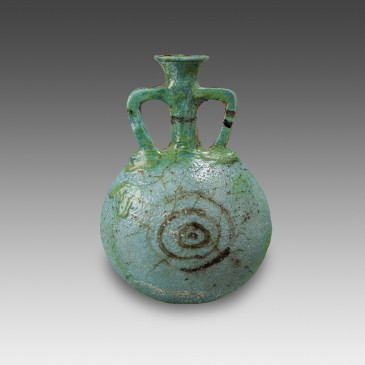
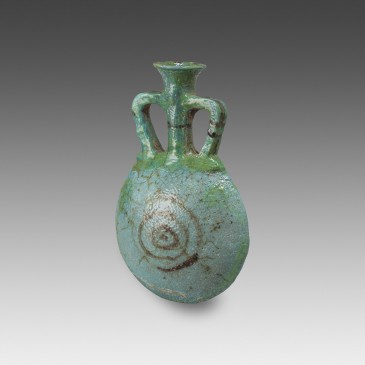
A vase with a distinctive appearance, as its circular body consists of two domed halves, yet its profile is almost flat: the boundary between the two halves is highlighted by a ridge.
13th century B.C., 14th century B.C.
H: 9.7 cm
In stock
Product Description
A vase with a distinctive appearance, as its circular body consists of two domed halves, yet its profile is almost flat: the boundary between the two halves is highlighted by a ridge. The neck, shaped like a small column, tapers to a funnel-shaped opening; it is reinforced by two square-sectioned handles. The decoration, rendered in black, consists solely of series of concentric circles painted on both sides and lines on the neck, handles, and rim.
This type of vase, which originated in the Near East, has a long history dating back at least to the 2nd millennium B.C. and continuing throughout the following millennium; its popularity spread to several regions of the ancient world, from Egypt to the Near East, and from Cyprus and Rhodes to the Aegean world. The most famous examples are the “New Year’s gourds,” which enjoyed great popularity in Egypt during the Saite Period (7th–6th centuries B.C.): they were associated with the festival on July 19 that celebrated the beginning of the Nile flood.
In the Late Bronze Age, the lenticular gourd appeared in a turquoise faience version with black decoration at sites along the Syrian-Palestinian coast (for example, at Ugarit) as well as in Egypt, featuring either simple decoration, as seen here, or, at times, more elaborate designs with figurative scenes. Terracotta versions belong to the repertoire of Cretan (Minoan period) and Greek pottery from the Mycenaean period (phases IIIB and IIIC, 14th–12th centuries BCE): their decoration is most often linear.
Given their rather small size and relatively low capacity, it is likely that these flasks contained cosmetic and semi-precious substances such as perfumes.


