
Ancient Art and Antiquities For Sale

Cart

View Cart
  • No products in the cart.
  • My Account
    • Edit address
    • Change password
    • View order
  • English
  • Login / Register
  • HOME
  • SHOP
  • ABOUT US
  • BLOG
  • CONTACT
  • BILIANAK.
  • PHOENIX ANCIENT ART
Back to top

Guttus with Spout and Strainer

Home  / Vessels / Guttus with Spout and Strainer

View cart “Large Chalice with Geometrical Decoration” has been added to your cart.

Guttus with Spout and Strainer

Guttus with Spout and Strainer

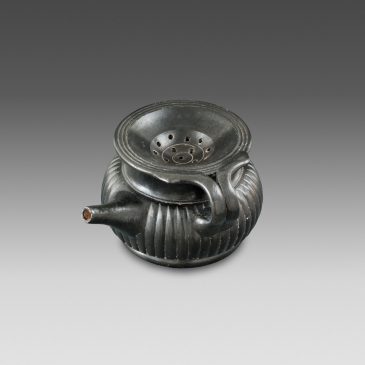
A small drinking vessel known as a ‘guttus’. It is a small container designed to fill other vessels, such as oil lamps, via its spout located on the body (which is slender and tapered on the vase in question). As its name suggests, the liquid flowed from it only in small quantities or drop by drop.The shape, size and technique thus allow us to date the production of this vase to Magna Graecia, during the first half of the 4th century BC.

Classical Greek, Italiote
4th century B.C.
H : 6.20 cm - D : 7.1 cm

In stock

In stock

Price:CHF 2'700

Category: Vessels. Tags: Black glazed, Guttus, Italiote, Italy, Magna Graecia, Spout, Strainer.

Love it, share it!

  • Description
  • Additional information
  • Product Inquiry

Product Description

A small drinking vessel known as a ‘guttus’. It is a small container designed to fill other vessels, such as oil lamps, via its spout located on the body (which is slender and tapered on the vase in question). As its name suggests, the liquid flowed from it only in small quantities or drop by drop.
In order to enable the user to grasp and handle this small vessel, a double handle extends from the top of the body down to the rim, forming an angular triangular surface.

On this example, the top of the guttus also features a wide mouth that curves inwards to form a sort of funnel acting as a filter-sieve.
From an ornamental perspective, a series of vertical ribs runs at regular intervals around the entire circumference of the vase’s body. Furthermore, three bands can be seen adorning the rim, echoing the three successive rows in which the filter holes are arranged. Apart from this, the entire vase is glazed entirely in black.
Glazed during firing, this glaze indeed offers a magnificent sheen that recalls the metallic origin of the tableware that served as a source of inspiration. The vase’s very regular shape, along with the small raised ribs and the angularity of the double handle at the top, clearly and effectively imitate the art of ‘toruetics’ (metal tableware shaped by cold hammering).

The glaze covers the entire exterior of the piece, with the exception of the underside, which reveals the raw, red colour of the clay, covered with a clay slip known as miltos. The presence of this red slip is evidence supporting the attribution of the vase under consideration to a colonial workshop: through this technique, the Italic potters sought to reproduce the characteristic reddish hue of Attic terracotta.

The shape, size and technique thus allow us to date the production of this vase to Magna Graecia, during the first half of the 4th century BC.

Additional information

Culture

Classical Greek, Italiote

Datation

4th century B.C.

Dimensions

H : 6.20 cm – D : 7.1 cm

Type

Vessel

Material

Ceramic

Colors

Black

Condition

Vase complete and practically intact; limestone remains on the bottom. Multiple traces of irregular rubbing.

Serial Number

11901

Other Products

  • Roman Ribbed Glass Bowl without Handles
    Details Add to cart
    ADDED

    Roman Ribbed Glass Bowl without Handles

    Roman Ribbed Glass Bowl without Handles

    This thick-walled bowl is outstanding both for its excellent state of preservation and for its perfect shape. It was molded and pressed in light green glass, while the finish was obtained by polishing and by grinding.

    CHF 2'000 Read More
  • Details Add to cart
    ADDED

    Small Mycenaean Pear-Shaped Jar

    Small Mycenaean Pear-Shaped Jar

    Skillfully wheel-made vessel provided with three handles that were modeled separately and applied to the shoulder before the firing process.

    This vessel with a sinuous profile and a circular, narrow base is very characteristic of Mycenaean culture: it is the reduced version of the large jars that can often be found in tombs and that would have served for the storage of the products used during funerary rituals.

    CHF 4'000 Read More
  • Details Add to cart
    ADDED

    Conical Bowl

    Near Eastern Conical Bowl

    In the Near Eastern world, stone vases were considered luxury goods and belonged to high-ranking individuals or to the treasures of sanctuaries: they were used to store valuable materials (ointments, liquids for female toiletry for instance; but also wheat, oils, etc., given the size of the vessel), as ritual vessels for religious cults, as grave goods.

    CHF 2'300 Read More

Blog

Antique Idols

As soon as humans were able to think, they consistently […]

Antiquity’s Colors

English Translation Soon Les œuvres qui nous sont parvenues de […]

Glassware production

Glass, a luxury and exquisite material, whose technical virtuosity reached […]

Categories

  • Artifacts
  • Events & exhibitions
  • Facts & Figures
  • The gallery
  • FAQs
  • Terms of Use
  • Terms of Sale
  • Contact us

©Designed by Webgenève - Création de site internet


Rue Etienne Dumont, 9 1204 Geneva
Tel. +4122 301 9378
Email: contact@young-collectors.com

This website uses cookies. If you continue browsing this website, your action is considered to be a cookie policy acceptance.
