
Ancient Art and Antiquities For Sale

Cart

View Cart
  • No products in the cart.
  • My Account
    • Edit address
    • Change password
    • View order
  • English
  • Login / Register
  • HOME
  • SHOP
  • ABOUT US
  • BLOG
  • CONTACT
  • BILIANAK.
  • PHOENIX ANCIENT ART
Back to top

Byzantine Terracotta Oil lamp

Home  / Vessels / Lamps / Byzantine Terracotta Oil lamp

View cart “Group representing a Grotesque Nurse and her Baby” has been added to your cart.

Byzantine Terracotta Oil lamp

Byzantine Terracotta Oil lamp

The shape, style and decoration of this example are typical of lamps produced during the final centuries of the Empire and the early Byzantine period: the most active workshops were located in North African cities, but their
products were often imitated elsewhere, notably in Italy and Gaul.

Byzantine
Half of the 5th - begining of the 7th century A.C.
L : 12.8 cm

In stock

In stock

Price:CHF 1'100

Category: Lamps. Tags: Byzantine, lamp, Oil, terracotta.

Love it, share it!

  • Description
  • Additional information
  • Product Inquiry

Product Description

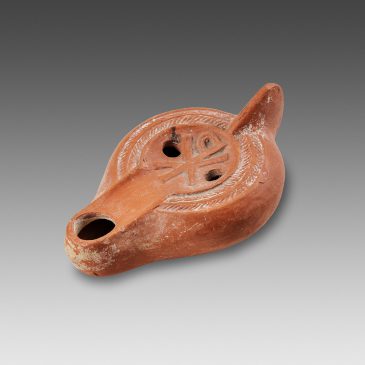
The lamp was moulded from a fine, brick-coloured clay and covered with a bright orange slip. The circular body is extended by a long, rounded channel, featuring a hole for the wick to emerge. A small, sturdy, hand-made handle is attached to the back. The base consists of a flat ring with a cord running up to the handle. The medallion features two parallel filling holes.

The decoration is confined to the medallion: a band adorned with a long fishbone surrounds one of the most widespread Christian iconographic motifs, the Constantinian chi-rho (here with the rho facing left). This symbol, composed of the first two letters of Christ’s name written in Greek (Χ, chi, and Ρ, rho), is most often associated with the first emperor to proclaim himself a Christian, Constantine the Great (emperor from 306 to 337 AD).

The shape, style and decoration of this example are typical of lamps produced during the final centuries of the Empire and the early Byzantine period: the most active workshops were located in North African cities, but their
products were often imitated elsewhere, notably in Italy and Gaul. Their remarkable success was undoubtedly due to their rich iconography, generally linked to Christian beliefs (scenes from the Old Testament, symbols such as the lamb, the dove, the fish, the palm tree or the chi-rho).

Additional information

Culture

Byzantine

Datation

Half of the 5th – begining of the 7th century A.C.

Dimensions

L : 12.8 cm

Type

Lamps

Material

Terracotta

Colors

Amber

Condition

Complete and virtually intact; some incrustations, small chips.

Serial Number

34194

Other Products

  • Grotesque Terracotta Head (Mime or Actor)
    Details Add to cart
    ADDED

    Grotesque Terracotta Head (perhaps a Mime or an Actor)

    Grotesque Terracotta Head (perhaps a Mime or an Actor)

    The statuettes of “grotesques” often represented mimes, street actors, music players, dancers, or even street vendors or workers suffering from physical deformities or afflictions that the sculptors treated in an exaggerated manner, to create a caricature-like effect. At the end of the Hellenistic period, in the large urban centers such as Rome and Alexandria, the theatrical genre of pantomime (according to tradition, this genre was created by Sophron of Syracuse in the 5th century B.C. already) was very popular.

    CHF 8'200 Read More
  • Grotesque Mask (Mime or Aulos Player)
    Details Add to cart
    ADDED

    Grotesque Mask (Mime or Aulos Player)

    Grotesque Mask (Mime or Aulos Player)

    This face certainly represents a male figure; it shows some of the distinctive features of the Greek-Roman images known as “grotesque”, such as the big aquiline and pointed nose, the strongly marked, frowning eyebrows and the wrinkled forehead.

    CHF 6'400 Read More
  • Details Add to cart
    ADDED

    Small Mycenaean Pear-Shaped Jar

    Small Mycenaean Pear-Shaped Jar

    Skillfully wheel-made vessel provided with three handles that were modeled separately and applied to the shoulder before the firing process.

    This vessel with a sinuous profile and a circular, narrow base is very characteristic of Mycenaean culture: it is the reduced version of the large jars that can often be found in tombs and that would have served for the storage of the products used during funerary rituals.

    CHF 4'000 Read More

Blog

Antique Idols

As soon as humans were able to think, they consistently […]

Antiquity’s Colors

English Translation Soon Les œuvres qui nous sont parvenues de […]

Glassware production

Glass, a luxury and exquisite material, whose technical virtuosity reached […]

Categories

  • Artifacts
  • Events & exhibitions
  • Facts & Figures
  • The gallery
  • FAQs
  • Terms of Use
  • Terms of Sale
  • Contact us

©Designed by Webgenève - Création de site internet


Rue Etienne Dumont, 9 1204 Geneva
Tel. +4122 301 9378
Email: contact@young-collectors.com

This website uses cookies. If you continue browsing this website, your action is considered to be a cookie policy acceptance.
