
Stela representing a Woman
The stele is like a large, almost rectangular slab. It depicts the bust of a woman with a somewhat stiff and impersonal expression, carved in very high relief. The base, the back and the sides are flat and roughly hewn: it is possible that it served as a funerary stele.
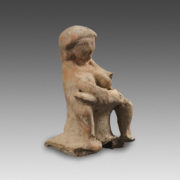
Statuette of a women breast-feeding a child
This statuette belongs to a significant series of figurines with similar characteristics originating from the Phoenician and Punic worlds. Generally dated to the 7th–6th centuries B.C., they may be standing or seated, holding a child or various attributes (musical instruments, a fan, ears of grain, etc.) or simply holding their breast or belly: in the latter case, they are often called dea gravida
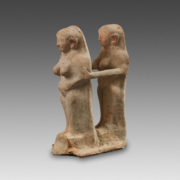
Group of two feminine statuettes
Levantine terracotta Group of two feminine statuettes from the 7th-6th century B.C. Complete and in good condition. Big chips on the basis. Concretion and few polychromy remains (brown-red).
This group belongs to a significant series of figurines with similar characteristics originating from the Phoenician and Punic worlds. Generally dated to the 7th–6th centuries B.C., they may be standing or seated, carrying a child or various attributes (musical instruments, a fan, ears of grain, brooches, etc.) or simply holding their breast or belly: in the latter case, they are often called dea gravida.
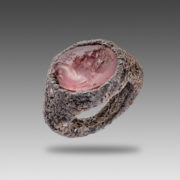
Ring with the Bust of Askelpios
The ring is made of solid silver and is hexagonal in shape, but unfortunately the metal has suffered severe corrosion. It is topped by a circular cabochon, cut from a disc of bright red carnelian, which features, carved into its hollow centre, a magnificent male bust: the figure depicted, seen in left profile, is Asclepius, with a youthful appearance.
Seal in the Shape of a Lion’s Head
Modeled in the shape of a stylized leonine protome (the head is complete, but the body is a simple half-circle representing the mane of the animal), it was carved from a cream-colored limestone veined with red; it is pierced vertically by a hole and was therefore intended to be worn as a pendant (necklace or bracelet).
The flat lower part of the object actually bears the seal of the owner and of his goods: it is adorned with drawings made with a bouterolle (a sort of drill).
Greek terracotta figure showing the myth of Europe
The group comprises two figures: with natural grace, a young woman rides astride a bull that is galloping rapidly towards the viewer’s right. Indeed, the young woman is Europa (the mythological figure after whom our continent is named), who was one of the three daughters of the King of Tyre (a major Phoenician coastal city). She was abducted by Zeus on the beach where she was playing with her sisters: the god appeared to her in the form of a magnificent white bull and carried her, riding the waves of the sea, all the way to Crete.
Amulet of a standing Bes
As usual, Bes sports a grimacing, grotesque expression, which makes him appear almost hilariously amused and thus portrays him as a positive and benevolent figure: his face is flattened and viewed from the front, with a wrinkled forehead crossed by thick eyebrows, wide-open eyes, a broad, flattened nose, ears reminiscent of a feline’s, and a beard ending in large, spiraling curls.
Black-Figure Lekythos
This lekythos has a rather stocky, rounded shape. It has a handle that forms a loop above the shoulder. The rim is flared and the neck is cylindrical and elongated. The base is circular and hollow.
Large Chalice with Geometrical Decoration
This vessel, the size of which makes it one of the largest examples currently known, attracts the eye of the modern viewer with its formal and decorative simplicity. It belongs to a group of well-attested ceramics in the so-called Chalcolithic period (the period that precedes the widespread use of metals, particularly copper and, later, bronze), on the sites of modern-day northern Iran.
Mummy Faience Bead Mask
This mask, delineated by three fringes of white, red and black beads, clearly highlights the anatomical details connected with the senses: the ears, the eyes with the black irises, the nose and the mouth made of red beads.
Large Ceramic Bowl
This Western Asian Large Ceramic Bowl with painted animals is made of beige ceramic covered with a red slip; the shape is simple, trunconical and without handles; the flat circular base provides the bowl a good balance.
Small Mycenaean Pear-Shaped Jar
Skillfully wheel-made vessel provided with three handles that were modeled separately and applied to the shoulder before the firing process.
This vessel with a sinuous profile and a circular, narrow base is very characteristic of Mycenaean culture: it is the reduced version of the large jars that can often be found in tombs and that would have served for the storage of the products used during funerary rituals.
©Designed by Webgenève - Création de site internet

Rue Etienne Dumont, 9 1204 Geneva
Tel. +4122 301 9378
Email: contact@young-collectors.com