
Pyxis with Bird-Shaped Lid

Pyxis with Bird-Shaped Lid
Pyxis with Bird-Shaped Lid
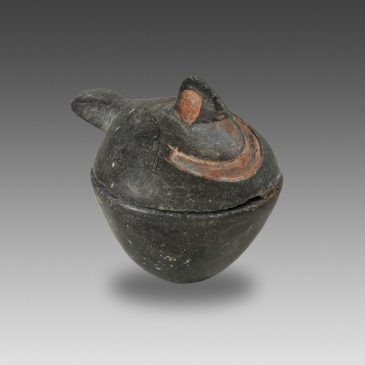
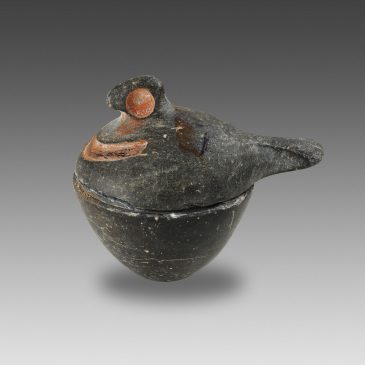
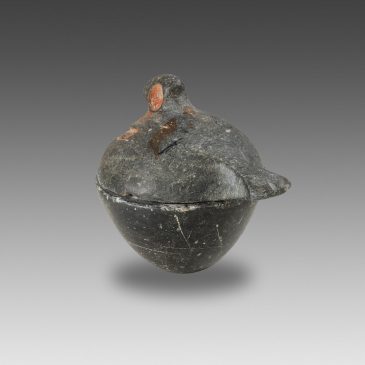
The body, which has a flat, circular base but does not ensure the vessel is well balanced, is hemispherical in shape: it has been carved with great precision. The lid, with its domed profile, depicts the body of a bird in a simple, stylised manner: it features a central, triangular knob and a small side handle, which correspond respectively to the bird’s head and tail.
2nd century B.C., 3rd century B.C.
Diam : 4.7 cm
In stock
Product Description
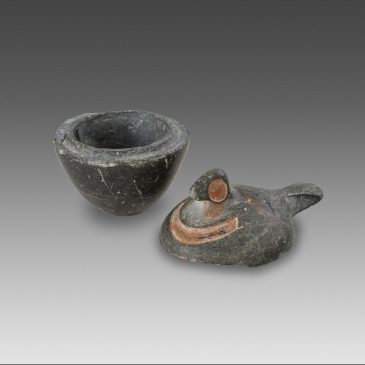
This tiny box (or pyx, to use the term derived from Ancient Greek) has a lid that fits perfectly onto the body thanks to a raised rim precisely carved into the rim. Traces of the chisel and other tools used to make the pyx are still visible on the inside, whilst the outer surface has been polished.
The body, which has a flat, circular base but does not ensure the vessel is well balanced, is hemispherical in shape: it has been carved with great precision. The lid, with its domed profile, depicts the body of a bird in a simple, stylised manner: it features a central, triangular knob and a small side handle, which correspond respectively to the bird’s head and tail. Furthermore, two large circular eyes and a broad collar, which were adorned with inlays—probably of stone—enrich the composition.
These small vessels are charming and rare objects: their stylistic, technical and material similarities link them to pyxides decorated with inlays of white, yellow or pink limestone, discovered at certain sites in Western Asia (ancient Bactria). Some of these examples are small in size, such as the pyx under consideration, whilst others, which are larger, have three or four internal compartments. The lid, shaped like a bird, appears to be unique to this piece.
Archaeologists generally date these objects to the Hellenistic period, that is, the period following Alexander the Great’s campaigns. They were probably typically feminine toiletries, used as containers for cosmetics or incense.


