
Ancient Art and Antiquities For Sale

Cart

View Cart
  • No products in the cart.
  • My Account
    • Edit address
    • Change password
    • View order
  • English
  • Login / Register
  • HOME
  • SHOP
  • ABOUT US
  • BLOG
  • CONTACT
  • BILIANAK.
  • PHOENIX ANCIENT ART
Back to top

Neolithic Polished Axehead

Home  / Arms & Armor / Neolithic Polished Axehead

View cart “Seated Statuette” has been added to your cart.
  • Neolithic Polished Axehead
  • Neolithic Polished Axehead
  • Neolithic Polished Axehead

Neolithic Polished Axehead

Neolithic Polished Axehead

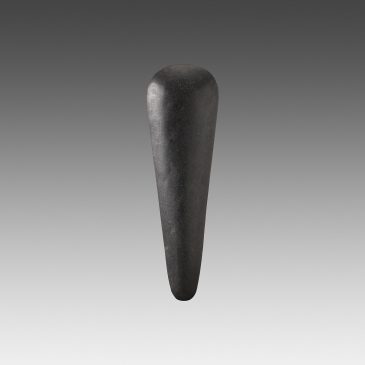
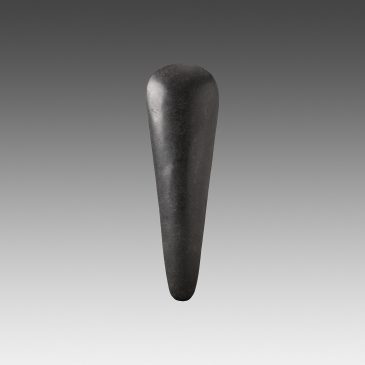
The axe was carved from a long, slender flake of stone, of a uniform, almost black colour. Its shape resembles that of a teardrop, with one end being thinner and almost pointed, whilst the other (which forms the cutting edge) has a distinctly arched profile, but appears never to have been sharpened.

European, Neolithic
3rd millenium B.C., 4th millenium B.C.
Long : 27.3 cm

In stock

In stock

Price:CHF 10'500

Category: Arms & Armor. Tags: Axe, Diorite, European, Neolithic, Neolithic Polished Axehead, Polished, Stone.

Love it, share it!

  • Description
  • Additional information
  • Product Inquiry

Product Description

The axe was carved from a long, slender flake of stone, of a uniform, almost black colour. Its shape resembles that of a teardrop, with one end being thinner and almost pointed, whilst the other (which forms the cutting edge) has a distinctly arched profile, but appears never to have been sharpened.

This type of axe was one of the key tools used by Neolithic farmers. It enabled them to fell trees and thus create new areas for cultivation in territories yet to be settled, which were covered in forests and vegetation that needed to be cleared.
They were first made by chipping or sawing, and then by whittling, shaping them as closely as possible to their final form in order to reduce the very long time usually spent on polishing. The handle was attached by drilling a long, narrow hole in a wooden stick, into which the narrow part of the axe was inserted and then secured with cord.

Exemplars as well-preserved and of such high technical and artistic quality as the one under consideration were probably symbols of prestige or power, rather than actual tools or weapons used on the battlefield. According to some archaeologists, who base their views partly on recent ethnological studies, the size of an axe was an indicator of its owner’s position in the hierarchy and of his wealth: the larger the tool, the more prominent a position he held within his clan or society.

Additional information

Culture

European, Neolithic

Datation

3rd millenium B.C., 4th millenium B.C.

Dimensions

Long : 27.3 cm

Type

Arms & Armor

Material

Diorite, Stone

Colors

Black

Condition

Complete and in good condition. Few chips. Polished surface.

Serial Number

20948

Other Products

  • Seal in the Shape of a Lion's Head
    Details Add to cart
    ADDED

    Seal in the Shape of a Lion’s Head

    Seal in the Shape of a Lion’s Head

    Modeled in the shape of a stylized leonine protome (the head is complete, but the body is a simple half-circle representing the mane of the animal), it was carved from a cream-colored limestone veined with red; it is pierced vertically by a hole and was therefore intended to be worn as a pendant (necklace or bracelet).

    The flat lower part of the object actually bears the seal of the owner and of his goods: it is adorned with drawings made with a bouterolle (a sort of drill).

    CHF 5'900 Read More
  • Anepigraphic Scarab
    Details Add to cart
    ADDED

    Anepigraphic Scarab

    Egyptian Anepigraphic Scarab

    The scarab is placed on a flat, elliptical base; the bottom has no inscription. Characterized by stylized, though complete and accurate shapes, this beetle shows elegant features that indicate the details of the anatomy.

    CHF 14'000 Read More
  • Seated Statuette
    Details Add to cart
    ADDED

    Seated Statuette

    Near Eastern Seated Statuette

    The figure, whose gender is not clearly defined (the absence of breasts and the low-detailed shapes would rather suggest a male body), is seated on a cubic stool without any carved details. The torso of the figure is straight, the back is smooth and without details; the legs are simple rods in light relief. The arms of the figure are folded and the triangular hands are brought back to the chest.

    CHF 13'500 Read More

Blog

Antique Idols

As soon as humans were able to think, they consistently […]

Antiquity’s Colors

English Translation Soon Les œuvres qui nous sont parvenues de […]

Glassware production

Glass, a luxury and exquisite material, whose technical virtuosity reached […]

Categories

  • Artifacts
  • Events & exhibitions
  • Facts & Figures
  • The gallery

Archives

  • December 2015
  • June 2015
  • March 2015
  • January 2015
  • December 2014
  • November 2014
  • October 2014
  • September 2014
  • August 2014
  • FAQs
  • Terms of Use
  • Terms of Sale
  • Contact us

©Designed by Webgenève - Création de site internet


Rue Etienne Dumont, 9 1204 Geneva
Tel. +4122 301 9378
Email: contact@young-collectors.com

This website uses cookies. If you continue browsing this website, your action is considered to be a cookie policy acceptance.
