Bottle with Decorations

Bottle with Decorations
Bottle with Decorations
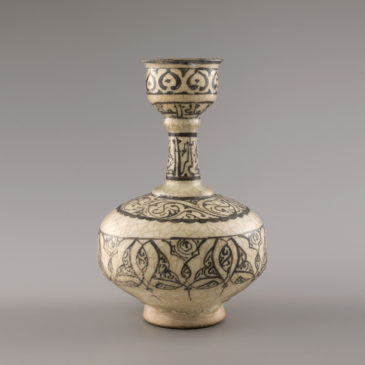
With no handles, this richly decorated bottle has a spherical yet flattened body, supported by a small ring-shaped base. It was probably used for serving drinks, as a piece of tableware.
13th century A.D.
H: 25 cm
In stock
Product Description
Devoid of handles, this richly decorated bottle has a spherical yet flattened body, supported by a small ring-shaped base; its tall, slender neck ends in an elegant spout resembling an upturned bell. It was probably used for serving drinks, as a piece of tableware.
Within the repertoire of Islamic ceramics, this type of bottle is a relatively rare form and one seldom produced by potters; nevertheless, it is well documented, particularly amongst the lustre ware of the Raqqa region (modern-day Syria) and further east in Kāchān (modern-day Iran). Among the finest examples are a number of bottles richly painted with gold motifs on a white background and others decorated with black motifs beneath a turquoise glaze.
The firing technique is known as the metallic lustre technique: this is one of the most significant contributions made by Islamic craftsmen to the development of ceramics, involving two distinct firing stages – the first to fire the clay body and the second to produce the lustre effect.
The vase under consideration, which is remarkable both for its balanced form and its highly elaborate decoration, was thrown from a cream-coloured clay adorned with motifs painted in black, beneath a transparent, colourless glaze. As is often the case, during firing the glaze partially ran and accumulated in greater quantities on the shoulder and, above all, in the lower part of the vessel (base).
The decoration, which is arranged in five friezes on the spout, the neck, the shoulder and the body (where the main frieze is located), is painted with thin black lines of varying thickness. These are abstract and stylised yet very elegant motifs, reminiscent of flowers, tendrils or, in places, inscriptions in Arabic calligraphy.