
Ancient Art and Antiquities For Sale

Cart

View Cart
  • No products in the cart.
  • My Account
    • Edit address
    • Change password
    • View order
  • English
  • Login / Register
  • HOME
  • SHOP
  • ABOUT US
  • BLOG
  • CONTACT
  • BILIANAK.
  • PHOENIX ANCIENT ART
Back to top

Islamic Vessel with Floral Decoration

Home  / Vessels / Islamic Vessel with Floral Decoration
View cart “Hemispherical Green Stone Bowl” has been added to your cart.
  • Islamic Vessel with Floral Decoration from the 13th century A.D.
Islamic Vessel with Floral Decoration
Islamic Vessel with Floral Decoration

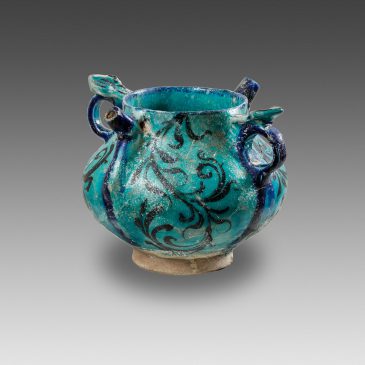
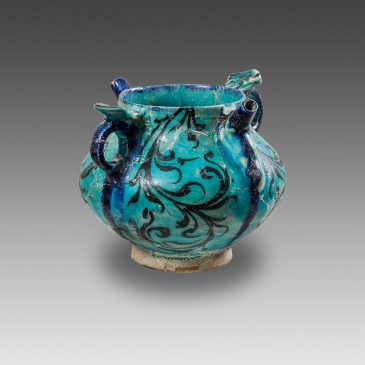
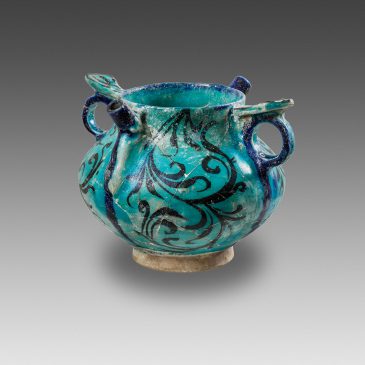
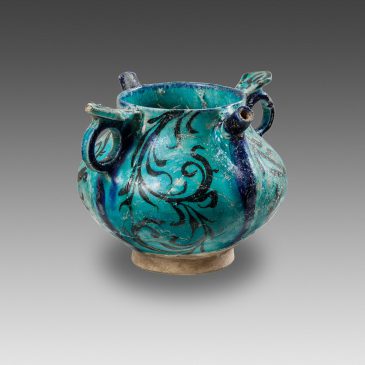
The vessel, wheel-thrown, is made of light grey-beige clay covered with a white engobe. The decoration appears to be painted in black beneath a magnificent turquoise glaze, which is slightly thicker on the base where it has partially built up.

The technique, form and decoration are characteristic of the highly glossy ceramics produced in the workshops of the city of Kashan, situated in the centre of present-day Iran.

Islamic
13th century A.D.
D : 12.4 cm

In stock

In stock

Price:CHF 4'800

Category: Vessels. Tags: Ceramic, Glazed, Islamic, Mask-Applique representing a Male Head, Turquoise, Vessel.

Love it, share it!

  • Description
  • Additional information
  • Product Inquiry

Product Description

The vessel, wheel-thrown, is made of light grey-beige clay covered with a white engobe. The decoration appears to be painted in black beneath a magnificent turquoise glaze, which is slightly thicker on the base where it has partially built up.

The shape is distinctive: it is a small jar supported by a ring-shaped base and fitted with two circular handles arranged vertically; above each handle, a small triangular surface allows for a better grip on the vessel, even with just one hand. The contents could be poured out easily and with good control thanks to two narrow, cylindrical spouts positioned perpendicular to the handles.

The technique, form and decoration are characteristic of the highly glossy ceramics produced in the workshops of the city of Kashan, situated in the centre of present-day Iran.

The colours turquoise, dark blue and black used here are undoubtedly elements that continue to contribute to the success of this type of pottery to this day. Dark blue lines divide the outer surface into four sections, each adorned with a large scroll of leaves and flowers: the airy, elegant motifs are hand-drawn and are similar but not identical.

The technique used (known as metallic lustre) involves two distinct firing stages: the first to fire the clay body and the second to produce the glossy glaze. Although there is still no consensus on its origin and history, it is thought that this technique was probably invented in Iraq between the 8th and 9th centuries AD; widely used by potters in Cairo during the Fatimid Dynasty (10th and 11th centuries AD), it appeared in the Syrian world in the 12th century. In Iran, it was not until the final decades of the 12th century that the production of lustre ware began: very quickly, the city of Kashan established itself as the main centre of production where, as evidenced by the legible signatures on numerous vessels, entire dynasties of potters worked. This technique remained in vogue until the 19th century AD.

Additional information

Culture

Islamic

Datation

13th century A.D.

Dimensions

D : 12.4 cm

Type

Vessel

Material

Terracotta

Colors

Black, Blue, Turquoise

Condition

Complete but reglued from several fragments.

Serial Number

9855

Other Products

  • Roman Small Glass Cup (Patella)
    Details Add to cart
    ADDED

    Roman Small Glass Cup (Patella)

    Roman Small Glass Cup (Patella)

    This small cup, which belonged to a famous collection of the 19th century, was mold-blown in a transparent glass with an originally bluish tinge.

    Used as tableware, these small cups served as drinking vessels but would have also been intended to contain various substances: sauces, spices, other condiments, etc. Produced mainly between the early Flavian period and the early 2nd century A.D., they exist in different versions that vary in the color, in the type of glass, or in details of the shape (shape of the lip, more or less rounded body, etc.).

    CHF 15'000 Read More
  • Details Add to cart
    ADDED

    Small Mycenaean Pear-Shaped Jar

    Small Mycenaean Pear-Shaped Jar

    Skillfully wheel-made vessel provided with three handles that were modeled separately and applied to the shoulder before the firing process.

    This vessel with a sinuous profile and a circular, narrow base is very characteristic of Mycenaean culture: it is the reduced version of the large jars that can often be found in tombs and that would have served for the storage of the products used during funerary rituals.

    CHF 4'000 Read More
  • Details Add to cart
    ADDED

    Bactrian Alabaster Chalice

    Bactrian Alabaster Chalice

    This object, whose shape recalls a chalice, was carved from a monolith of calcite (alabaster) that is similar in color and appearance to the stone commonly used by Egyptian sculptors for luxury tableware in the late 4th millennium B.C. already.

    CHF 7'800 Read More

Blog

Antique Idols

As soon as humans were able to think, they consistently […]

Antiquity’s Colors

English Translation Soon Les œuvres qui nous sont parvenues de […]

Glassware production

Glass, a luxury and exquisite material, whose technical virtuosity reached […]

Categories

  • Artifacts
  • Events & exhibitions
  • Facts & Figures
  • The gallery
  • FAQs
  • Terms of Use
  • Terms of Sale
  • Contact us

©Designed by Webgenève - Création de site internet


Rue Etienne Dumont, 9 1204 Geneva
Tel. +4122 301 9378
Email: contact@young-collectors.com

This website uses cookies. If you continue browsing this website, your action is considered to be a cookie policy acceptance.
