
Ancient Corinthian Greek Terracotta Lekanis with Panthers, a Sphinx, and Harpies

Ancient Corinthian Greek Terracotta Lekanis with Panthers, a Sphinx, and Harpies
Ancient Corinthian Greek Terracotta Lekanis with Panthers, a Sphinx, and Harpies
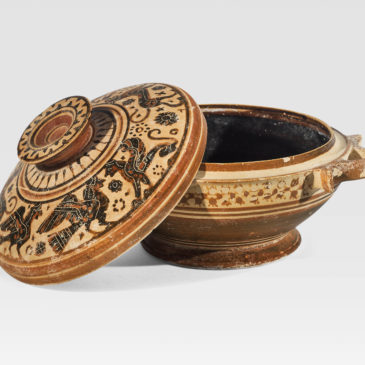
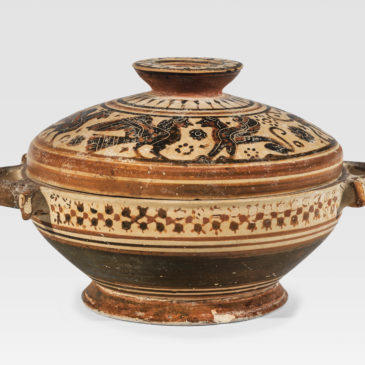
The lekanis has twin spurred handles on either side of a shallow footed bowl, decorated by three rows of red pomegranates along the rim and a series of red, black, and clay colored bands below
6th century B.C.
H: 9 cm
Product Description
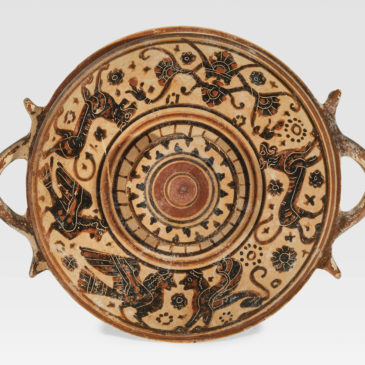
The lekanis has twin spurred handles on either side of a shallow footed bowl, decorated by three rows of red pomegranates along the rim and a series of red, black, and clay colored bands below. Narrow concentric red bands continue in the black-glazed interior, and on the outer bands of the lid. The lid features a frieze with a foliate design of palmettes, tendrils, and lotus buds heraldically flanked by two panthers behind a sphinx and two harpies. A star pattern on the concave knob radiates outward from a red medallion, while rosettes and rings of sunburst dots fill the field.
Resting in a shallow groove slightly behind the rim of the bowl, the lid fits over an offset vertical flange that helps to keep the lid firmly in place. The lid is decorated with a single Corinthian style frieze of profile animals and monsters. A foliate design of palmettes, tendrils, and lotus buds is heraldically flanked by two panthers. Behind the panthers are a sphinx and a harpy, who both look toward a second harpy standing between them and facing the sphinx. A generous amount of ‘splinter rosettes’, rosettes with incised arc facing away from the center, amorphous and cruciform rosettes, and rings of ‘sunburst’ dots fill the field comfortably. Above the frieze, a star pattern of twenty-seven points radiates out from the knob, which itself is decorated with an outer band of loosely interlocking black trefoils around alternating concentric bands of black and red which terminate in a red medallion at the center of the knob’s concavity.
Greek, Corinthian, ca. 600 – 575 B.C.
Provenance: The Gilbert collection, Cambridge, Massachusetts, acquired in New York, 29 July 1997.
Exhibited: La Biennale, Grand Palais, Paris, 11-17 September 2019; PAD London, Berkeley Square, London, 30 September 6 – October 2019
Published: The Gilbert Collection: by Phoenix Ancient Art, New York, 2019, no. 114


